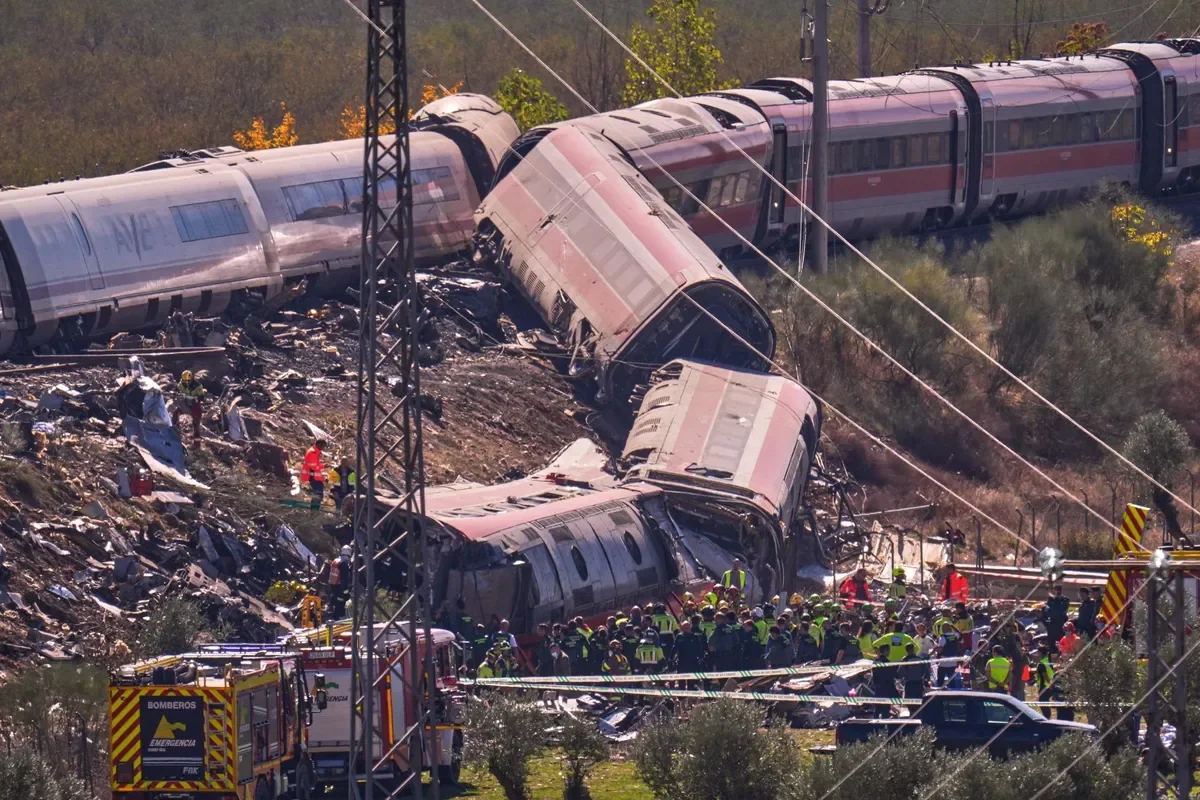
At least 64 people were killed and more than 80 injured on Wednesday, October 28, when two high-speed trains collided near Urda, in the province of Toledo, central Spain, triggering a major emergency response and an outpouring of condolences from European leaders.
According to information released by the regional government of Castilla-La Mancha, the death toll increased as rescue teams gained access to the most severely damaged carriages, some of which derailed and fell down an embankment.
The accident occurred at approximately 8:54 a.m. local time on the railway section between Los Yébenes and Urda, involving a high-speed train operated by Spain's state-owned Renfe and another belonging to the private railway company Iryo.
According to figures released by Spanish authorities, the Renfe train was carrying 397 passengers, while the Iryo service had 147 people on board, including a baby. A total of 544 passengers were involved in the collision.
Initial reports indicated that the Renfe train collided with the Iryo service, which was reportedly stationary on the tracks, causing several carriages to derail.
Regional authorities also reported more than 80 injuries, including at least 15 people in critical condition, who were transported to different hospitals.
High-speed rail services between Madrid and Andalusia were suspended in both directions as Spanish authorities began investigating the circumstances surrounding the collision.
Spanish Government Cancels Official Engagements Following Tragedy
In response to the scale of the disaster, Spanish Prime Minister Pedro Sánchez cancelled his public engagements scheduled for Wednesday, alongside several government ministers and political leaders.
The president of the Castilla-La Mancha regional government, Emiliano García-Page, travelled to the accident site to monitor emergency operations and support the rescue teams.
Renfe activated its crisis management unit and its Assistance Plan for Railway Accident Victims and Their Families, providing support to those affected.
Emergency operations involved firefighters, Civil Guard officers, Civil Protection teams and healthcare professionals, who worked to assist injured passengers and evacuate people trapped inside damaged carriages.
The exact cause of the accident has not yet been officially established, with investigations underway to determine the circumstances of the collision.
European Leaders Express Solidarity With Spain
The tragedy prompted reactions from several European leaders, who expressed condolences to the victims' families and solidarity with the Spanish people.
European Commission President Ursula von der Leyen said she had received news of the collision with deep sadness and conveyed a message of support to those affected.
"Today, Europe mourns with you," she wrote in a message shared on social media.
French President Emmanuel Macron described the accident as a terrible railway tragedy and expressed France's solidarity with Spain, extending his support to the victims, their families and emergency personnel involved in rescue operations.
Italian Prime Minister Giorgia Meloni also expressed solidarity with the Spanish government, highlighting the efforts of emergency response teams.
Portuguese Prime Minister Luís Montenegro offered condolences and made Portugal's assistance available to the Spanish authorities.
"Our deepest solidarity goes to the families of the victims of the serious railway accident in Toledo, Spain," Montenegro said.
Similar messages were issued by representatives from Germany, Ukraine, Sweden, the Netherlands and the Baltic states, who expressed shock and sadness over the scale of the tragedy.
WHO Cancels Event in Madrid
The World Health Organization (WHO) also expressed solidarity with the victims, with its Director-General, Tedros Adhanom Ghebreyesus, announcing the cancellation of an event scheduled for Wednesday in Madrid.
The ceremony, organised in collaboration with the Pau Gasol Foundation, was cancelled as a mark of respect for the victims and their families.
"This is a painful day for Spain," the WHO chief said while extending his condolences to those affected.
Meanwhile, Spanish authorities continue to monitor the condition of injured passengers and assess the damage caused by the collision.
The death toll may change as rescue and identification operations continue, while investigators work to establish the causes of one of the deadliest railway accidents recorded in Spain in recent years.