Professor Calton Cadeado, a specialist in International Relations, Peace and Security, says several of the social and economic conditions that fuelled public discontent in Mozambique remain unresolved, warning that the country could face new protests if the underlying causes are not addressed.
Cadeado made the remarks during an interview on the We Talk Business podcast, hosted by Dr. Zeiss Lacerda, where he discussed the post-election protests, youth unemployment, population growth, poverty and the gap between economic growth reported in statistics and what citizens actually experience in their daily lives.
Youth Frustration Has Reached a Saturation Point
For Cadeado, interpreting the protests solely through the lens of the electoral dispute ignores other pressures that had already been building within society.
He points particularly to the situation of young people in urban areas, where unemployment and unmet expectations continue to generate frustration.
“The frustration of young people in the cities has reached a saturation point,” he said.
Cadeado argues that accumulated frustration can quickly turn into aggression when a triggering event emerges.
“Frustration generates aggression. It only needs a spark to ignite it,” he said.
In his assessment of the recent protests, Cadeado described Venâncio Mondlane as a catalyst for dissatisfaction that, in his view, already existed.
“In the recent protests, we saw that Venâncio was the spark that was waiting to ignite,” he said.
Cadeado, however, rejects explanations based on a single factor and argues that social and political conflict usually results from a combination of causes.
Parents Were Also on the Streets
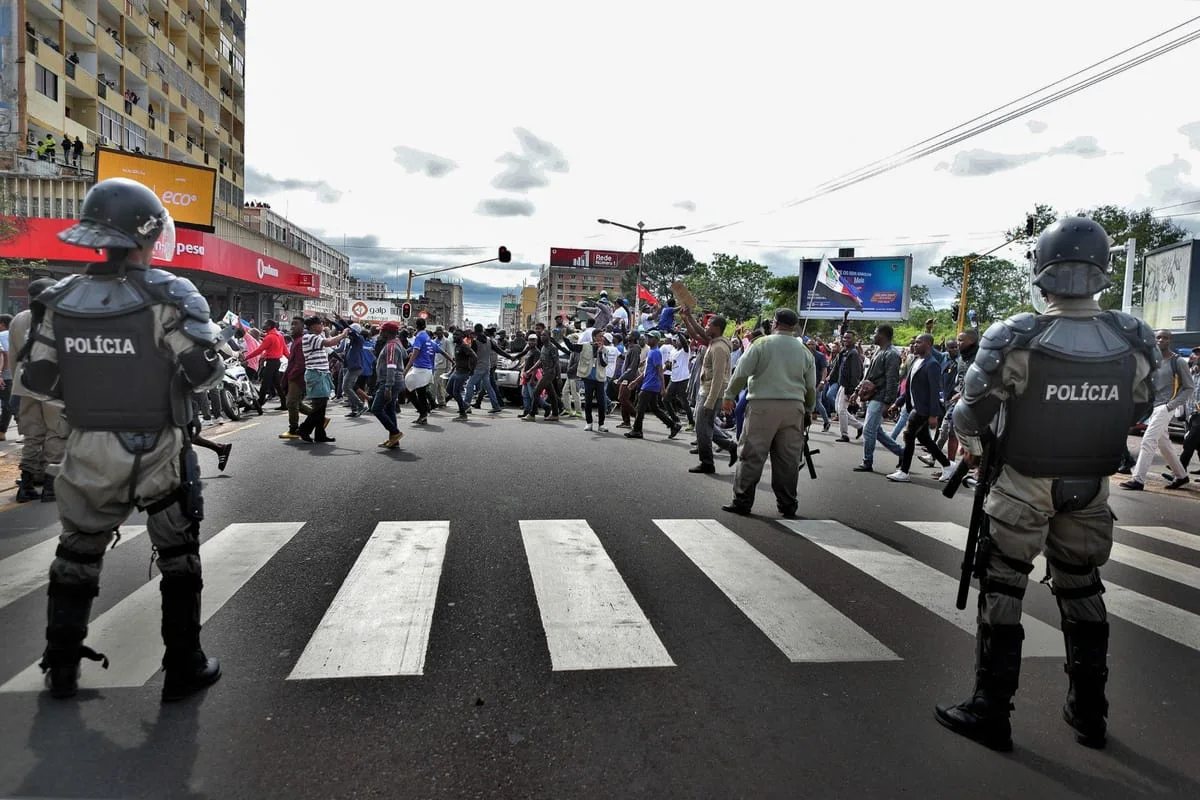
The specialist also stressed that the demonstrations did not involve only young people.
“It was not only young people who were there. There were fathers there, there were mothers there,” he said.
According to Cadeado, one of the concerns he observed among protesters was the future of educated young people who remain unemployed.
“Those people were saying: ‘My child has no job’,” he said.
Cadeado argues that many families invest their limited resources in educating their children in the hope that education will lead to better living conditions.
When those young people complete their studies and still cannot find opportunities, he says, frustration increases both among the youth and within the families that invested in their education.
Imagem de apoio. Entretanto, quando esses jovens terminam os estudos e não encontram oportunidades, aumenta a frustração tanto dos próprios jovens como das famílias que investiram na sua formação.
Population Growth Increases Pressure
Another factor highlighted by Cadeado is population growth, particularly among young people.
He argues that although Mozambique is geographically large, population growth must be assessed against the country’s economic capacity to meet the needs of its citizens.
In his view, the problem is not simply the number of people, but the relationship between population growth, available jobs, public services and the amount of wealth being generated.
Cadeado links this situation to what he describes as a cycle of poverty reproduction, in which limited resources are shared among large families, making it more difficult to achieve sustainable improvements in living standards.
“The Government has its share of responsibility. But we also need to start discussing responsibility at family level,” he said.
According to the academic, even strong economic growth may fail to produce broad improvements if population growth continues to increase pressure on the resources and opportunities available.
Economic Growth That Does Not Reach People’s Pockets
Cadeado also says it is important to distinguish between economic growth recorded in official statistics and what ordinary people actually feel in their lives.
“The country may statistically show growth, but the citizen’s pocket does not show the same feeling,” he said.
According to the professor, building schools, hospitals, roads and other infrastructure is important, but citizens increasingly judge government performance by the concrete impact those investments have on their lives.
“What has that changed in my life?” he asked, describing the question citizens increasingly use to assess public achievements.
In his view, the gap between institutional indicators and the reality experienced by families can contribute to perceptions of stagnation and deepen social dissatisfaction.
“The Scenario Is That We Could Have New Protests”
When discussing possible future scenarios, Cadeado said he had previously been criticised for raising the possibility of further demonstrations.
“Someone accused me of trying to predict or promote new protests,” he said.
He rejected that interpretation, arguing that he was simply analysing the conditions that remain present in the country.
“Based on the data we are seeing, the scenario is that we could have new protests,” he said.
He added: “Because the conditions are still there.”
For Cadeado, discussing that possibility does not mean supporting new demonstrations, but recognising that some of the factors behind public dissatisfaction remain unresolved.
No Single Cause
Despite his warning, Cadeado insists that protests or conflicts of this scale should not be explained through a single factor.
“In conflict studies, we strongly reject the idea of a single factor,” he said.
According to him, individual, family, community, economic, demographic, political and state-level factors can operate simultaneously.
In his assessment, understanding these different elements is essential to reducing the risk of future conflicts escalating into violence and instability.
Cadeado argues that addressing the underlying causes of dissatisfaction requires greater attention to young people, employment, education, the quality of economic growth and the way political and social conflicts are managed.
#Governação#Calton Cadeado Alerta Que#Condições Para Novas Manifestações#Continuam Presentes.#Calton Cadeado#Cadeado#Manifestações#Crescimento