The official results, announced on Sunday, November 8, by the Independent Electoral Commission (IEC), confirm the weakening of the ANC, which, despite remaining the most voted-for party nationally, has lost a significant share of the electoral support it accumulated over recent decades.
The Democratic Alliance (DA) finished second with 24.64% of the vote, followed by uMkhonto weSizwe (MK), the party associated with former President Jacob Zuma, which secured 9.76%. The Economic Freedom Fighters (EFF) obtained 6.22%, while ActionSA won 5.67%.
The ANC's decline contrasts sharply with the political dominance it has maintained since 1994, when Nelson Mandela became South Africa's first democratically elected President. For many years, the party secured substantial majorities, but its electoral support has steadily declined in successive elections.
In the 2021 local elections, the ANC had already experienced a significant drop in support, falling below 50% nationally. Five years later, the latest results indicate a deepening of that trend amid growing fragmentation of South Africa's political landscape.
Decline in Major Cities as Opposition Gains Ground
The ANC's weakening was particularly evident in the country's major metropolitan areas, where the Democratic Alliance strengthened its electoral position.
In cities such as Johannesburg, Pretoria and Ekurhuleni, the ANC lost its position as the leading party, while the DA emerged as the strongest electoral force. In Cape Town, the Democratic Alliance retained control of the municipal administration.
In the eThekwini metropolitan area, which includes Durban, uMkhonto weSizwe emerged as the most voted-for party, confirming the influence of Jacob Zuma's political movement in KwaZulu-Natal province.
Despite these losses, the ANC maintained a significant presence across several regions, remaining the country's largest political party and securing representation in numerous municipal councils.
According to the results announced by the Electoral Commission on Sunday, the ANC won 3,246 seats in local government bodies, compared with 1,695 for the Democratic Alliance and 785 for MK.
Public Dissatisfaction Over Basic Services Shapes Electoral Context
The ANC's electoral decline comes amid growing public dissatisfaction with the quality of basic services and living conditions.
Problems involving water supply, electricity disruptions, deteriorating roads, irregular waste collection and allegations of corruption have dominated political debate in South Africa.
These issues were particularly significant during the local elections, as municipalities are responsible for providing several essential services to communities.
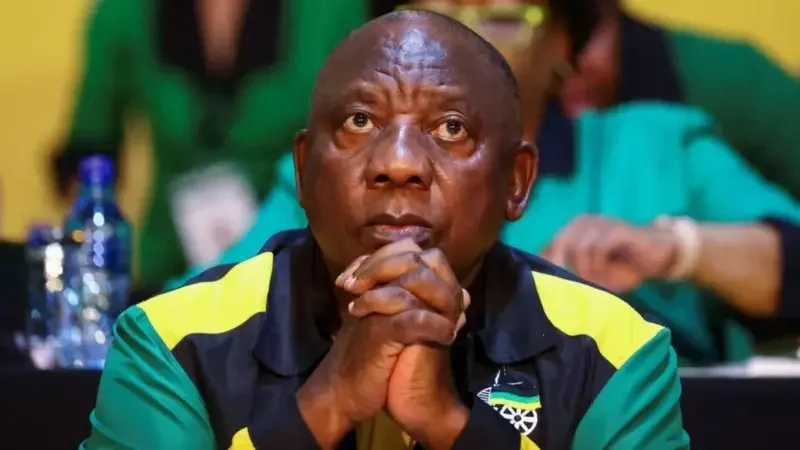
ANC Secretary-General Fikile Mbalula acknowledged the seriousness of the results, describing the party's electoral performance as catastrophic and emphasising the need to regain public trust.
Meanwhile, South African President Cyril Ramaphosa called for humility and stressed the importance of placing citizens' interests at the centre of political decision-making.
New Political Landscape Forces Parties to Negotiate Coalitions
The absence of outright majorities in numerous municipalities is expected to intensify negotiations between political parties over the formation of local governments.
The new political landscape could require the ANC to reach agreements with other parties to maintain its influence in the administration of strategic cities, including major economic centres.
The Electoral Commission declared the elections free and fair, reporting that approximately 14.9 million voters participated, representing 52% of registered voters, compared with 45.9% in 2021.
Although it remains the country's largest political party by national vote share, the ANC now faces the challenge of rebuilding lost support and adapting to an increasingly competitive political system in which coalition agreements play a growing role in local governance.