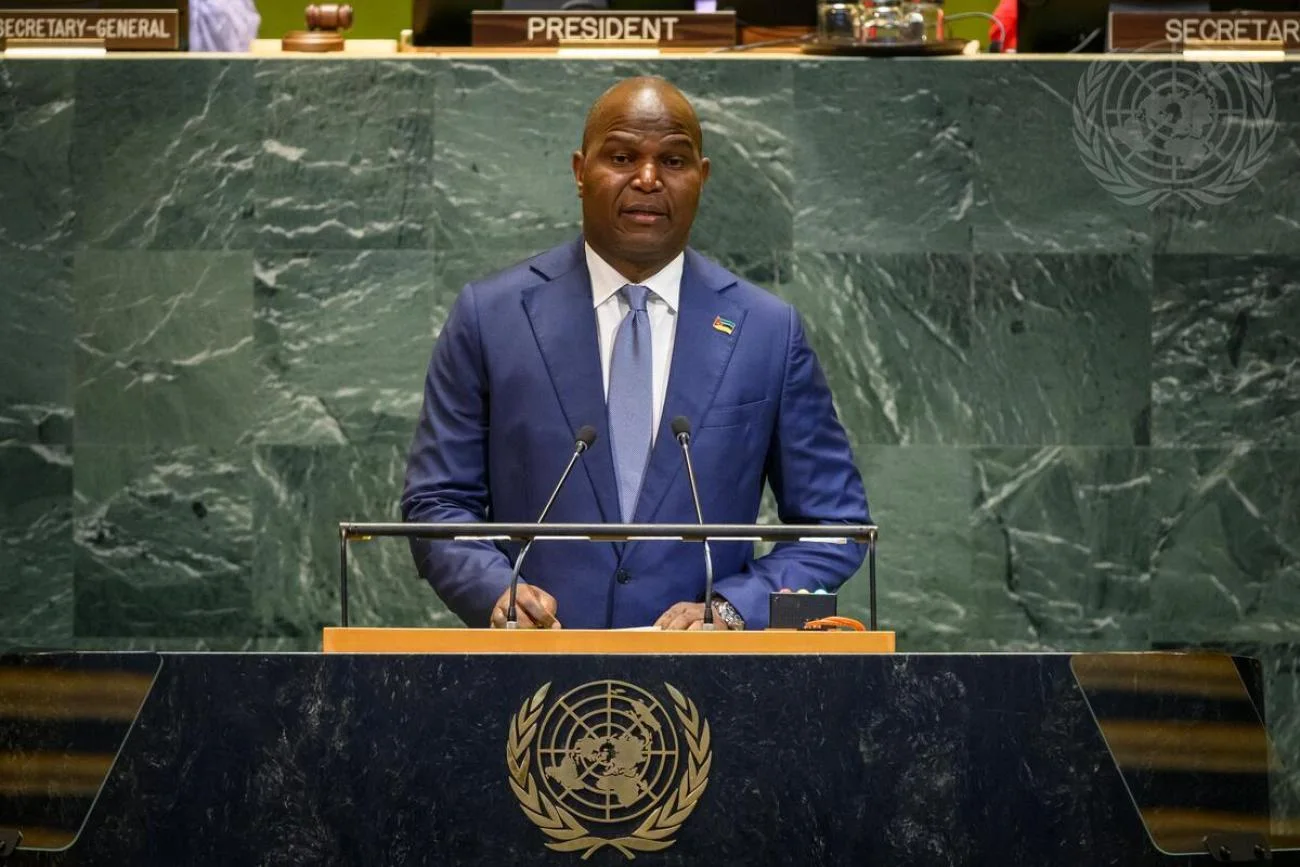
Chapo said the current global governance structure continues to underrepresent the African continent and backed the African Union’s common position set out in the Ezulwini Consensus and the Sirte Declaration.
The proposal calls for at least two permanent seats for Africa on the Security Council, with the same privileges as current permanent members, including veto power for as long as that mechanism remains in place, as well as five non-permanent seats for the continent.
During his speech, Chapo also defended stronger multilateralism, international cooperation and respect for international law as key tools for addressing armed conflicts, humanitarian crises, terrorism, climate change and economic inequalities.
The Head of State reaffirmed Mozambique’s support for a two-state solution to the Israeli-Palestinian conflict and for the right to self-determination of the Sahrawi people.
He also called for the lifting of the economic, commercial and financial blockade on Cuba and for sanctions against Zimbabwe to be removed.
On Mozambique, Chapo highlighted efforts to stabilise Cabo Delgado and acknowledged the support provided by regional and international partners in the fight against terrorism.
According to the President, despite progress in the security situation, the province still requires support for reconstruction and development.
On the economic front, Chapo argued that Africa’s natural resources should generate greater value within the continent through industrialisation, local processing and the development of national and regional value chains.
The President also addressed the impact of climate change in Mozambique and called for greater access by vulnerable countries to adaptation finance, loss and damage mechanisms, and investment in resilient infrastructure and early warning systems.
In the technology sector, he advocated investment in connectivity, scientific research, training, technology transfer and responsible governance of artificial intelligence.
Chapo concluded his address by calling for a more representative United Nations capable of responding to political, economic, climate and technological transformations.