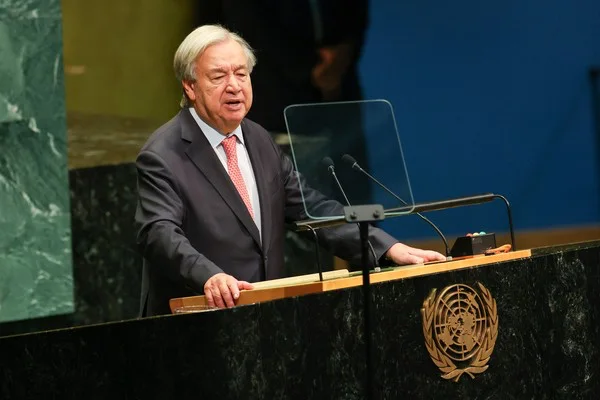
Guterres made the statement on Tuesday, 22 September, during the opening of the 81st session of the United Nations General Assembly in New York. It was his final opening address at the annual gathering as secretary-general.
“We must reform the Security Council so that it reflects today’s world, with the legitimacy and effectiveness that today’s challenges require,” he said.
The secretary-general once again highlighted Africa’s absence among the permanent members as one of the main inequalities in the current composition of the Security Council, whose structure retains features established after the Second World War.
At present, the five permanent members of the Security Council are China, the United States, France, the United Kingdom and Russia. All possess veto power. Africa, despite comprising 54 United Nations member states, has no permanent seat on the body.
Guterres has argued in recent years that this situation must be corrected, saying it is unjustifiable for a continent with more than one billion inhabitants to remain without permanent representation in one of the United Nations’ main decision-making bodies.
In his speech, the UN chief also warned of the worsening of conflicts, geopolitical divisions, inequalities and human rights violations in different parts of the world.
According to Guterres, the past decade has been marked by wars with devastating consequences, in which civilians have been turned into targets, hunger has been used as a weapon and international law has repeatedly come under pressure.
The secretary-general also addressed the conflicts in the Middle East, Ukraine and Sudan, calling for stronger diplomacy, dialogue and international cooperation.
Reforming multilateral institutions was presented as one of the necessary responses to changes in the global economic, political and demographic balance.
In addition to Security Council reform, Guterres drew attention to the challenges posed by artificial intelligence and called for international mechanisms to ensure that the technology is developed and used safely and responsibly.
António Guterres’s term at the helm of the United Nations ends at the end of 2026, after ten years in office.